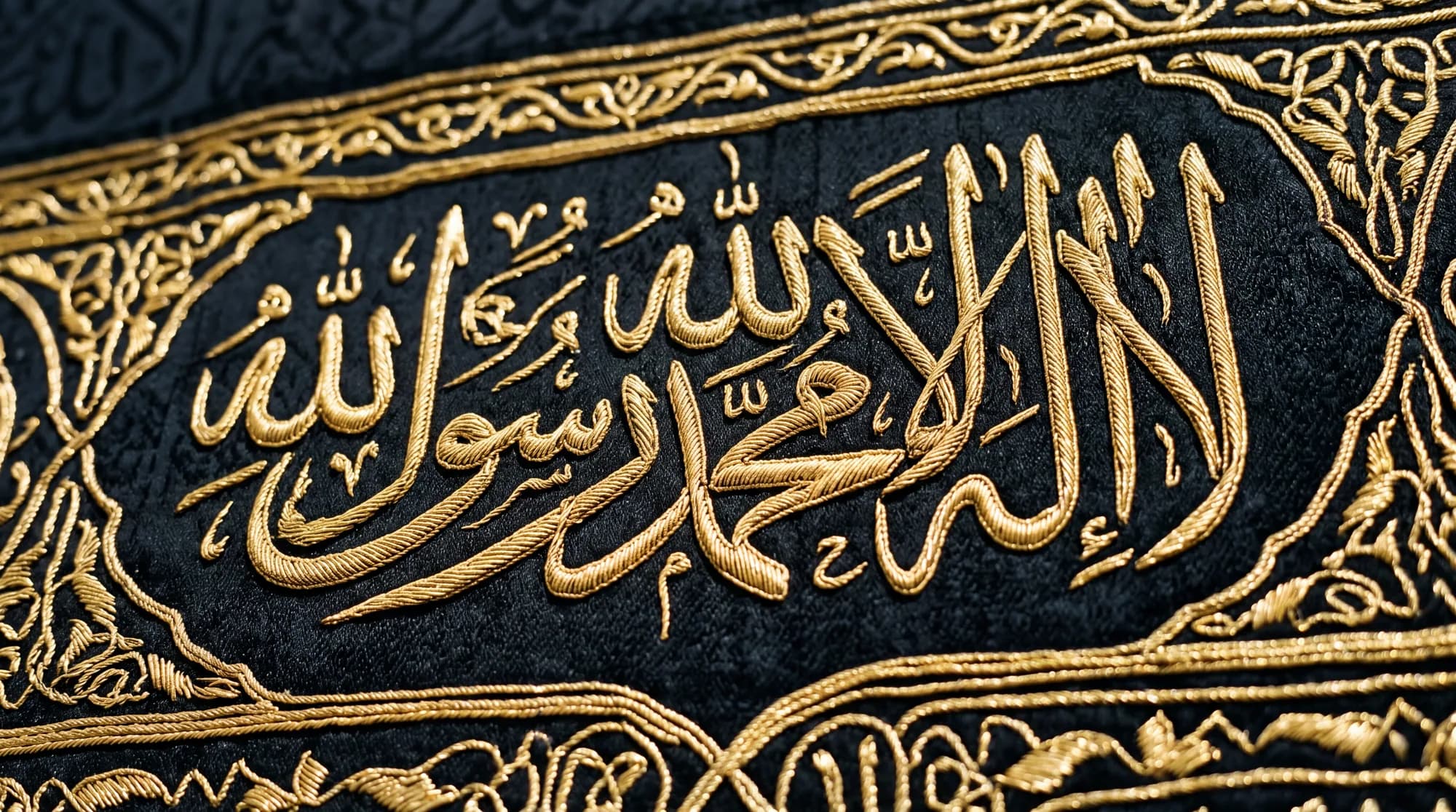
Before you travel — preparation
Settle debts, return what was entrusted, ask forgiveness from those you may have wronged, and write your will. The Prophet ﷺ taught that the pilgrim leaves on a journey from which they may not return — settle the worldly account first. Pack ihram garments for men (two unsewn white sheets — izar and rida); women wear normal modest clothing. Hygiene supplies and unscented soap are essential since fragrance is prohibited in ihram.
Step 1 — Entering Ihram at the Miqat
Ihram is both the special state and the garments. You enter ihram at the miqat — the boundary point appropriate to where you are coming from (e.g. Dhul Hulayfah for those coming via Madinah, Yalamlam for those coming from Yemen, Qarn al-Manazil for those coming via Ta'if). For pilgrims arriving by air, the captain typically announces when you cross the miqat. You may take ghusl, perform two rakahs, and then state the niyyah for Umrah and recite the Talbiyah.
- Take ghusl (full bath) if you can
- Perfume your body before donning ihram (men)
- Don the ihram garments — two white unsewn sheets for men, modest dress for women
- Pray two rakahs as Salat al-Ihram (some perform this; others consider it not specifically prescribed)
- Make the niyyah in your heart for Umrah
- Begin the Talbiyah — and recite it often from this moment onward
The Talbiyah
Recited frequently from the moment of ihram until you begin tawaf in Mecca. Men recite it audibly; women quietly.
Restrictions during ihram
While in ihram you avoid: cutting hair or nails, wearing perfume, hunting, sexual relations, contracting a marriage, and any quarrelling or sin. Men avoid sewn clothing, head coverings, and closed-toe shoes. Women may wear ordinary modest clothing but should not cover the face or wear gloves (different schools handle this slightly differently — consult your local guide).
Step 2 — Arriving at Masjid al-Haram
Enter the Masjid with your right foot first. The first sight of the Kaaba is one of the most powerful moments in a pilgrim's life. The du'a at first sight is not specified by an authentic hadith — many du'as are recommended; the Prophet ﷺ would simply make du'a at this moment in his own words. Whatever you ask at this moment, ask sincerely.
Step 3 — Tawaf (seven circuits of the Kaaba)
Tawaf begins at the Black Stone (Hajar al-Aswad) corner. You approach, point or kiss it (do not push others), say Bismillah Allahu Akbar, and begin walking with the Kaaba on your left. Make seven complete circuits, each ending back at the Black Stone with another Bismillah Allahu Akbar.
- Stand facing the Black Stone, raise your right hand toward it, say 'Bismillah, Allahu Akbar'
- Walk anti-clockwise — Kaaba on your left
- Men perform raml (brisk walk with shoulders rolled) for the first three circuits in Umrah; ordinary walking for the rest
- At each completion at the Black Stone, repeat 'Bismillah, Allahu Akbar'
- Du'a freely throughout — there is no required wording, only sincerity
- Between the Yamani Corner and the Black Stone, recite the Quranic du'a (below)
- After 7 circuits, pray two rakahs behind Maqam Ibrahim if possible (or anywhere in the masjid)
- Drink Zamzam water and pour some on your head
Du'a between the Yamani Corner and the Black Stone
The Prophet ﷺ would consistently recite this Quranic du'a during tawaf, between the Yamani Corner and the Black Stone.
Step 4 — Sa'i between Safa and Marwa
Sa'i commemorates Hajar's running between the two hills searching for water for her infant son Ismail (peace be upon him). You walk seven trips (one-way) starting at Safa and ending at Marwa. Men jog the marked green-light section in the middle; women walk the whole way. There is no specific du'a required — du'a in your own words is encouraged.
- Begin at Safa. Face the Kaaba and recite the verse 'Inna-s-safa wa-l-marwata min sha'a'irillah' (Q 2:158) once
- Say 'Allahu Akbar' three times and supplicate facing the Kaaba
- Walk to Marwa — men jog the marked section between the green lights
- At Marwa, repeat the takbir and du'a, facing the Kaaba
- Walk back to Safa — that is two trips
- Continue alternating until you have made seven one-way trips, ending at Marwa
Du'a at Safa (and at Marwa)
Recited facing the Kaaba at the start of each trip from Safa, and again from Marwa.
Step 5 — Tahallul (exit from ihram)
After completing sa'i, men shave their heads completely (preferred) or trim hair from all over (permissible). Women cut a fingertip's length from the end of their hair. Once this is done, the state of ihram ends — restrictions are lifted, normal clothing may be worn again. Your Umrah is complete.
After Umrah — staying in Mecca
Many pilgrims spend additional days in Mecca after their Umrah is complete, performing extra tawaf (called Tawaf al-Tatawwu), reading Quran near the Kaaba, and praying in Masjid al-Haram. The Prophet ﷺ said: 'A prayer in this masjid is better than a thousand prayers elsewhere.' (Sahih Bukhari 1190).
Visiting Madinah
Most pilgrims travel from Mecca to Madinah (or vice versa) to pray in Masjid an-Nabawi and visit the grave of the Prophet ﷺ. This visit (ziyarah) is highly recommended though not part of Umrah itself. At the Prophet's grave, send salam:
Reflection
Umrah is the most accessible major spiritual journey in Islam. The four core rites — ihram, tawaf, sa'i, tahallul — can be completed in a few hours by a healthy adult. What makes them transformative is not the difficulty but the symbolism: the unstitched white cloth equalises the rich and poor; the circuits around the Kaaba unite every pilgrim from every land; the run between the hills connects you to the very moment Allah saved Hajar and her son. Bring this guide to the holy sites if you can; the screens are dim there, but the words are timeless.
Primary sources
- Quran on pilgrimage: 2:158, 2:196–203, 22:26–37
- Sahih Bukhari (Book of Hajj and Umrah, multiple narrations)
- Sahih Muslim 1184, 1218, 1230, 1394
- Sunan Abu Dawud 1892