Sirah
The chronological life of the Prophet Muhammad ﷺ, the era of the four Rightly-Guided Caliphs that followed, and supplementary chapters on key figures and events. Every event sourced from the Quran or the major Sirah and historical collections. No figural depiction — environments, narrative, and citations only.
20 chapters: the prophetic biography from birth in Mecca through the Farewell Sermon (chapters 1–14), then the Rashidun era — Abu Bakr, Umar, Uthman, Ali (chapters 15–18), then supplementary chapters — Khadija (RA) and the Tabuk Expedition (chapters 19–20).
Chapters
- Chapter01Year of the Elephant· ~570 CE
Birth in the Year of the Elephant
Mecca, in the late sixth century, was a small but strategic trading city in the Arabian peninsula. At its heart stood the Kaaba, a structure of pre-Islamic veneration built by Ibrahim and Ismail (peace be upon them), now surrounded by 360 idols. The Quraysh tribe held custodianship. Into this world the Prophet Muhammad ﷺ was born — orphaned before birth, into a year that the Quran itself records as miraculous.
Read chapter - Chapter02Pre-prophethood Mecca· ~570–595 CE
Childhood, Loss, and Marriage to Khadijah
From birth onward, the Prophet ﷺ knew loss. He grew up under the protection of relatives who themselves passed away one by one, until he found stability in his marriage to Khadijah — a partnership that would carry him through the first revelation.
Read chapter - Chapter03Year 1 of Prophethood· 610 CE
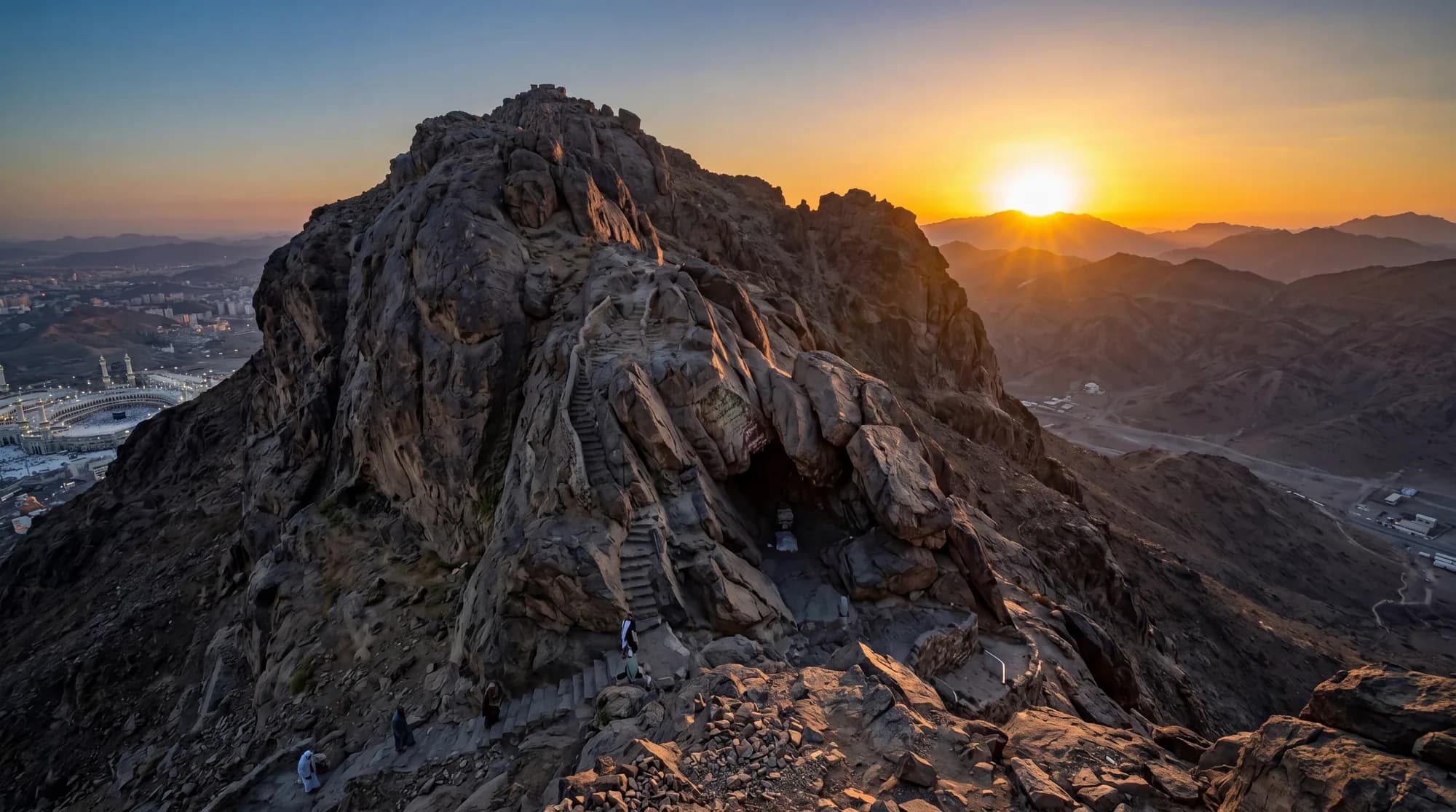
The First Revelation in Cave Hira
By his late thirties, the Prophet ﷺ had developed a habit of withdrawing for periods of solitary contemplation in a small cave on Mount Hira, just outside Mecca. There, in his fortieth year, the angel Jibril came to him with the first words of the Quran.
Read chapter - Chapter04Years 1–3 of Prophethood· 610–613 CE
The Early Years of Secret Preaching
After the first revelation, there was a brief period — described in the hadith literature as the 'pause' (fatra al-wahy) — before further revelations came. When they resumed, the Prophet ﷺ spent the first three years of his mission building a small, private community of believers in Mecca.
Read chapter - Chapter05Years 4–10 of Prophethood· 613–619 CE
Public Preaching and the Persecution
After three years of building a quiet community, the Prophet ﷺ received the command to preach openly. The reaction of the Quraysh leadership was hostile from the start, and within years their hostility hardened into systematic persecution of the believers.
Read chapter - Chapter06Year 10 of Prophethood· 619 CE
The Year of Sorrow
Following the end of the boycott, the Prophet ﷺ lost in quick succession the two people who had most stood by him for ten years — his beloved wife Khadijah and his protective uncle Abu Talib. The Muslim historians named this period 'Aam al-Huzn — the Year of Sorrow.
Read chapter - Chapter07Year 11 of Prophethood· ~620 CE
The Night Journey and the Ascension
After the Year of Sorrow, when the Prophet ﷺ had nearly run out of human consolation, Allah granted him the most extraordinary night of his life: the Isra (the night journey from Mecca to Jerusalem) and the Mi'raj (the ascension through the seven heavens). The five daily prayers were prescribed during this journey.
Read chapter - Chapter08Year 13 of Prophethood· 622 CE
The Hijra to Madinah
The Quraysh had escalated from persecution to plotting assassination. Meanwhile, in the city of Yathrib (later renamed Madinah), groups of Arabs had embraced Islam and pledged to protect the Prophet ﷺ if he came to them. The migration that followed marked the start of the Islamic calendar.
Read chapter - Chapter09Year 2 AH· 624 CE
The Battle of Badr
Two years after the Hijra, with the Muslim community now established in Madinah, a Quraysh trade caravan returning from Syria became the trigger for the first major battle in Islamic history. What began as a planned interception of the caravan became, by Allah's decree, a confrontation with the full Meccan army at the wells of Badr — outnumbered roughly three to one, the small Muslim force was given a victory the Quran would later call the Day of Furqan, the Day of Distinction between truth and falsehood.
Read chapter - Chapter10Year 3 AH· 625 CE
The Battle of Uhud
A year after the defeat at Badr, the Quraysh marched on Madinah with a force three times larger, intent on revenge. The Muslims met them at the foot of Mount Uhud, north of the city. What began as another victory turned, in a single moment of broken discipline, into the most painful day the early Muslim community would experience — a day the Quran itself dissects, naming the lesson and the cost.
Read chapter - Chapter11Year 5 AH· 627 CE
The Battle of the Trench (Khandaq)
Two years after Uhud, a coalition of Quraysh, allied Arab tribes, and dissenting groups within Madinah's neighbourhood mounted the largest force the peninsula had ever seen against the Muslims — around ten thousand fighters. Faced with an army several times their own size, the Muslims took the unprecedented step of digging a trench around the exposed northern approach to Madinah, on the suggestion of the Persian Companion Salman al-Farisi.
Read chapter - Chapter12Year 6 AH· 628 CE
The Treaty of Hudaybiyyah
In the sixth year after the Hijra, the Prophet ﷺ saw in a dream that he and his Companions entered Mecca and performed the lesser pilgrimage at the Kaaba. He set out with around fourteen hundred Muslims in pilgrim's dress, unarmed except for travelling swords, to make Umrah. The Quraysh, panicked, mobilised to block them. What followed was not a battle but a negotiation — a treaty whose terms looked like a loss to most Companions, and which the Quran would call a clear victory.
Read chapter - Chapter13Year 8 AH· 630 CE
The Conquest of Mecca
Two years after Hudaybiyyah, the Quraysh's allies Banu Bakr attacked the Khuza'a — allies of the Muslims under the treaty — killing several inside the sacred precinct. The Prophet ﷺ gave Quraysh three options to make amends. They refused. He then mobilised an army of ten thousand and marched on Mecca with such secrecy that the city did not know he was coming until his fires were lit on the surrounding hills. The conquest that followed is, in scale of forces against bloodshed, one of the most remarkable in recorded history — an entire city captured with almost no fighting at all.
Read chapter - Chapter14Year 10 AH· 632 CE
The Farewell Sermon and Final Days
In the tenth year after the Hijra, the Prophet ﷺ performed the Hajj — his first and only complete pilgrimage. Around one hundred and twenty thousand Muslims travelled with him. On the ninth day of Dhul Hijjah, standing on the plain of Arafat, he delivered the sermon that would become known as the Khutbat al-Wada — the Farewell Sermon — addressed not only to those present but to every generation of Muslims who would come after. Within months, he would return to Allah.
Read chapter - Chapter15Year 11–13 AH· 632–634 CE
Abu Bakr as-Siddiq — the First Caliph
When the Prophet ﷺ passed away, the community fractured for a moment. Abu Bakr — the closest companion, the man of the cave, the father of Aisha — stepped forward to address the gathered Muslims and steady them. Within days he was acknowledged as the leader. He ruled for just over two years, and in that short time he held the community together through three crises that would have broken almost anyone: the Ridda wars, the standing-down of Usama's army, and the first compilation of the Quran.
Read chapter - Chapter16Year 13–23 AH· 634–644 CE
Umar ibn al-Khattab — the Second Caliph
Umar's ten years as caliph reshaped the political map of the world. By the time of his death, the Muslim community ruled territory stretching from Libya in the west to Persia in the east, the Byzantine Levant had fallen, the Sasanian empire had collapsed, and Jerusalem had opened its gates to him personally. He simultaneously built the administrative machinery — the Hijri calendar, the diwan (registry of stipends), the standing-army garrison cities of Kufa, Basra, and Fustat — that would carry the empire for centuries. He lived modestly, walked the streets of Madinah at night to check on the people, and was assassinated in his own masjid while leading the Fajr prayer.
Read chapter - Chapter17Year 23–35 AH· 644–656 CE
Uthman ibn Affan — the Third Caliph
After the council of six convened in 23 AH, Abdur-Rahman ibn 'Awf removed himself from the running and undertook three days of consultation with senior Companions and ordinary Muslims in Madinah. The pledge was given to Uthman. He led the community for 12 years — the longest of the Rashidun caliphates. His era saw the empire continue to expand (the conquest of Cyprus, Tripolitania, parts of Khurasan), the building of the first Muslim navy, and most lastingly, the standardisation of the Quranic text into a single recension that has been the basis of every Mushaf since. The final years of his caliphate were turbulent and ended in his assassination by rebels in his own home — a wound the community took generations to fully process.
Read chapter - Chapter18Year 35–40 AH· 656–661 CE
Ali ibn Abi Talib — the Fourth Caliph
After the assassination of Uthman, the people of Madinah pressed Ali to accept the caliphate. He was the cousin and son-in-law of the Prophet ﷺ, husband of Fatima, father of Hasan and Husayn — and one of the four most senior Companions. He accepted reluctantly, knowing he was inheriting a community whose unity had been broken by the previous month's events. His four-and-a-half-year caliphate was consumed by the First Fitna — the civil conflicts that pitted Muslims against Muslims for the first time, including the Battles of the Camel and Siffin and the emergence of the Khawarij. He was assassinated in 40 AH while walking to lead the Fajr prayer in the masjid of Kufa. His scholarship, courage, and eloquence remain reference points across all Islamic traditions.
Read chapter - Chapter19Pre-prophethood through Year 10 of prophethood· ~555–619 CE
Khadija bint Khuwaylid — the First Believer
Before there was an ummah, there was Khadija. The Prophet ﷺ's first wife, the first person to believe in him as a messenger, the mother of his daughters, the financial backbone of the early dawah, and the woman whose loss in Year 10 of prophethood was the immediate trigger for what became known as the Year of Sorrow. Her biography fills in the picture the central Sirah cannot — the years before public revelation, the household life of the Prophet ﷺ, and the model of marriage the early community built itself around.
Read chapter - Chapter20Year 9 AH· October 630 CE
The Tabuk Expedition — the Hour of Hardship
After the Conquest of Mecca and the Battle of Hunayn, news reached Madinah that the Byzantine Empire was massing a force on the northern Arabian frontier to invade. The Prophet ﷺ called for a campaign. The conditions could not have been worse: peak summer heat, a long famine, the date harvest just ripe and waiting to be picked, and the destination 700 km away through arid desert. The Quran would later call the army that responded the 'Army of Hardship' (Jaysh al-'Usra). It was the last campaign the Prophet ﷺ personally led, and one of the most-studied Sirah events for what it reveals about the spectrum of believer-responses to a hard call.
Read chapter
Sirah content is historical narrative drawn from the Quran and the major biographical sources (Ibn Hisham's recension of Ibn Ishaq, Ibn Sa'd, Bukhari, Muslim). Specific narrations vary in chain strength; consult qualified scholars before treating any incident as definitive.